The short answer
Ask the supplier to state the exact model, structural system, governing standard and edition, plus the loads and environmental criteria used for the quoted configuration. Record wind, snow, rain, temperature, enclosure, anchorage and every site input still required. Local professionals and the authority having jurisdiction confirm the project-specific path.
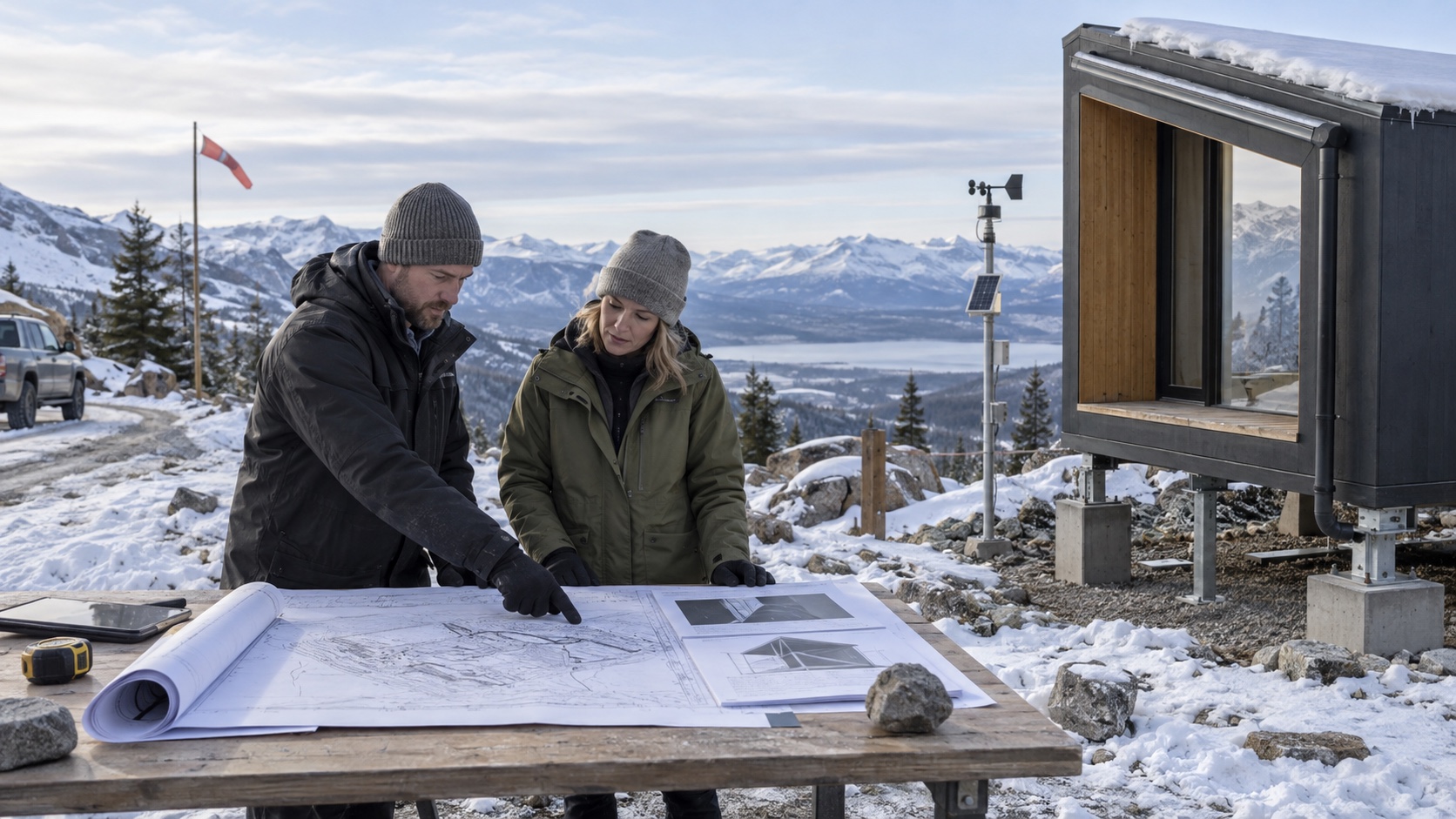
A photograph cannot prove that a unit fits an exposed site.
The quote needs a dated design basis tied to the proposed location and use. “Engineered,” “four season” and “built for snow” are descriptions, not design criteria.
Design basis
A climate claim needs a location.
Bushtec Safari's Glamping Show Americas exhibitor profile was the discovery source. Its public Shaka page lists a standard size and identifies frame, flysheet and canvas materials. Those facts describe the product. The page does not present a US site-specific wind speed, snow load, exposure category, foundation reaction schedule or approval conclusion. That gap is normal at discovery stage. It belongs in the request for quote.
ASCE says its Hazard Tool supplies location-based parameters used with ASCE 7 and ASCE 41, including wind, snow, rain, ice and other hazards. The address matters. So do the adopted code edition, risk category and local amendments selected by the responsible team.
Exact configuration
Model, dimensions, extensions, openings, attached rooms and equipment covered by the engineering.
Location criteria
Governing standard and edition, wind basis, snow or roof-load basis, rain, temperature and exposure inputs.
Project boundary
Support reactions, connection geometry, sealed deliverables, site work, exclusions and open inputs.
Site inputs
Put the assumptions beside the rating.
For wind, ask for the speed basis, risk category, exposure, enclosure classification and any topographic or debris inputs. A single mph number is hard to compare because it may not explain pressures on openings, cladding, connections or anchorage.
For snow, identify whether the value is ground snow load, flat-roof snow load or another result. Request the assumptions for drifting, sliding, unbalanced accumulation, rain-on-snow and local elevation where they apply. ASCE's Hazard Tool documentation notes that some locations require a site-specific case study and that authority requirements are not included in the lookup.
Florida shows why the jurisdiction belongs in the file. The Florida Building Commission states that the 8th Edition (2023) Florida Building Code took effect on December 31, 2023, and publishes current supplements and wind resources. A statewide resource is not a product approval or a local site decision.
Connections
Connect the unit file to the ground.
Ask for support locations, reactions, uplift and lateral demands, tolerances and required connection geometry. The local designer needs enough information to design the foundation, deck or anchoring system for the actual soil and exposure.
Bushtec's current terms place responsibility on the client for accurate project information and say client-provided substructures such as decks, slabs or ring beams affect the work and warranty. Those are one supplier's terms, not an industry rule. They show why scope and design inputs belong in writing before deposit.
Climate envelope
Guest comfort needs its own criteria.
Ask for the indoor and outdoor temperatures used to size heating and cooling, plus the insulation, air-sealing, window, ventilation and condensation-control basis. A room can remain standing and still perform poorly for guests or maintenance.
Record roof drainage, entry protection, flashing interfaces, platform drainage and the runoff path around supports and utilities. For fabric systems, ask how membranes, liners, openings and field joints are handled in wind-driven rain.
The operating file should include inspection intervals, fastener or tension checks, snow-removal instructions if any, replacement parts and the conditions that trigger closure or inspection.
Quote comparison
Compare evidence, not adjectives.
Put candidates into one table. Keep three states visible: supplied, pending and not applicable with a named reason. Pending information is normal when the supplier needs a survey, address or local design criteria. It becomes a procurement risk when the deposit is due before the missing input can change price or scope.
A lower quote may omit the local engineer, foundation, anchors, glazing package, insulation change, climate equipment or field inspection. Bring those items into the complete project budget before comparing totals.
Pre-order gate
Close six questions before procurement.
The property address and intended hospitality use are recorded.
The local team has identified the applicable code path and location inputs.
The supplier has named the exact model, configuration, standard and design criteria.
Unit reactions and connection requirements can be handed to the site designer.
Envelope and mechanical assumptions match the intended operating season.
Each missing input has an owner, due date and stated effect on price or schedule.
Use the cabin quote guide to keep factory, freight and site scope separate. The project team guide assigns the authority and professional roles.
FAQ
Questions behind a climate-ready quote.
Is a published wind or snow rating enough to approve a unit?
No. Ask what the rating means, which model and configuration it covers, which standard and edition were used, and which location assumptions apply. The authority having jurisdiction and qualified professionals still determine the project path.
Can the ASCE Hazard Tool design the cabin?
No. ASCE describes the tool as a way to look up location-based hazard parameters. It does not replace model-specific engineering, local code review, load combinations, connections or foundation design.
What if the site has little or no snow?
Keep the snow basis in the record and focus the review on the hazards and climate conditions that apply. Wind, rain, flood, heat, corrosion, humidity and debris exposure may control other parts of the design.
Does “four season” define insulation or HVAC performance?
No. Request the actual envelope, window, ventilation, heating and cooling criteria for the quoted configuration and intended location.
Does the UNIKOST calculator provide wind or snow loads?
No. It flags climate exposure as a planning workstream. It does not calculate structural loads, energy performance, code compliance, price, occupancy or approval.
Sources
Discovery item and primary references checked September 20, 2026.
- Glamping Show Americas 2026: Bushtec Safari exhibitor profile
- Bushtec: Shaka standard size and materials
- Bushtec: current terms of service
- ASCE: Hazard Tool
- ASCE: structural engineering publications and ASCE/SEI 7
- Florida Building Commission: current code resources
- Florida Building Commission: Building Code Information System
Bushtec pages are first-party product and contract material. They do not establish site-specific approval, US engineering, warranty coverage or suitability. ASCE and Florida Building Commission sources define research and authority boundaries. No endorsement, supplier relationship, permit, structural capacity, completed project or performance result is claimed. Author and reviewer: Alex Green, Manager.
Have the site and a proposed unit?
Expose the climate evidence still missing from the quote.
The calculator identifies planning workstreams. It does not calculate structural loads, energy performance, code compliance, price, occupancy or approval.
Run the project calculator