The short answer
EcoCamp Patagonia connects Torres del Paine as the reason to travel, guided outdoor days, several dome room types and communal evening spaces. The useful planning question for another owner is how the guest moves through the whole stay: attraction, activity, gathering and room. EcoCamp’s Chilean setting and published practices do not establish permission, cost or performance on a North American property.
The walk back from a Patagonian trail does not end at a cabin door.
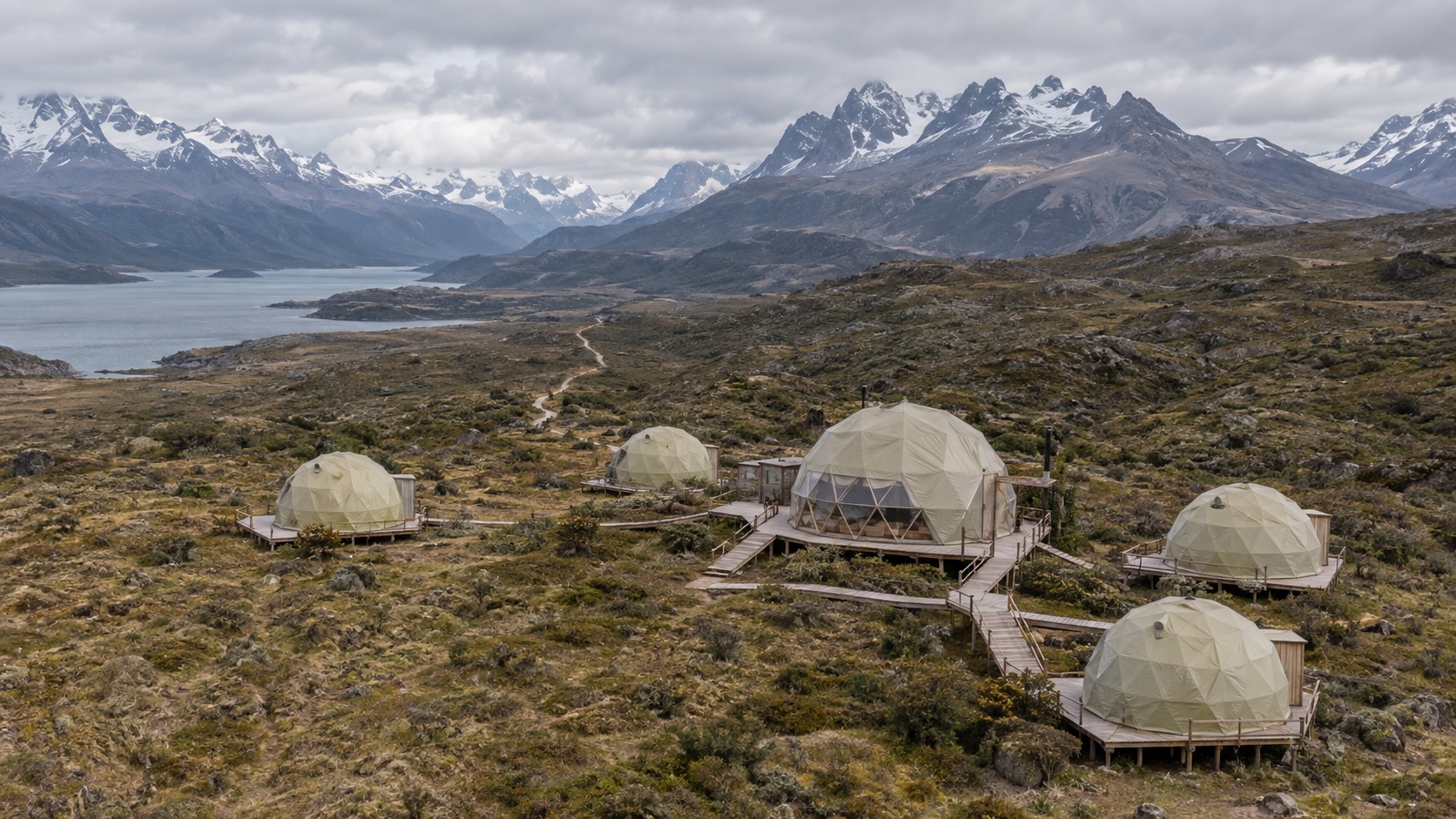
EcoCamp describes a sequence from guided excursions to a shared meal, then along a boardwalk to a sleeping dome. A dome shell alone cannot deliver that sequence. The operator’s site shows how room, program and common space support the destination guests came to experience.
A Glamping Show Americas article about OVO Patagonia, published January 16, 2026, prompted this separate question about place-led stays. OVO is another operator. That magazine story is not our source for EcoCamp facts and this article does not reproduce its structure.
Destination
The landscape supplies a reason to travel.
EcoCamp’s lodge page describes guided treks and wildlife outings by day, with dinner and accommodation at night. Torres del Paine’s terrain and trails are central to that promise. The room is where an active day ends, not the whole reason for making the trip.
For another property, place the actual attraction on the concept drawing. It might be a lake, ranch program or nearby town. Record access time, who runs the activity and what happens when weather changes the plan. A private deck with a view can be valuable; it cannot substitute for an itinerary when the booking promise is an active stay.
EcoCamp operates in an established Chilean destination. Another owner cannot borrow its park relationship, guide access, approvals or demand. Those need evidence tied to the actual parcel.
Room roles
The domes are different rooms, not one repeated shape.
EcoCamp’s dome directory lists Standard, Superior, Suite and Suite Loft options. Its Standard Dome page describes shared bathrooms and a spare room. Higher categories present private bathrooms and heating; the Loft is positioned for families or groups. Those differences alter paths, cleaning, service demand and the guest’s expectations.
Write a room-role schedule before making a unit shortlist. Who sleeps there? Which facilities are inside and which are shared? How is the room described at booking? A shared bath can be coherent when the description, path and bathhouse operation agree. A family room changes more than floor area.
Use the project-brief guide and hospitality-before-the-build guide to put the room promise beside the operating plan.
Site systems
Environmental statements need operating records.
EcoCamp’s green-ethos page describes solar panels, micro-hydro generation, raised platforms, composting toilets and biofiltration. It also describes the share of electricity its renewable systems provide. These are the operator’s claims. We have not audited energy accounts, equipment operation, certification scope or ecological outcomes.
For a new site, ask where power, heat and hot water come from in its own climate. Which paths and platforms suit the soils and accessibility route? Who maintains the wastewater system? Qualified local designers and authorities decide the applicable path. A remote lodge’s equipment list is not a permit template.
Guest-facing sustainability copy needs current evidence about the actual equipment, operating records and the limits of any third-party review. A landscape photograph does not prove a low-impact or carbon-neutral result.
Your property
Draw one complete guest day.
Trace arrival, the first night, an active day, a weather-interrupted day and departure. Place the room, gathering space, trail or other attraction, service access, food and utilities on the same plan. Name the person responsible at each handoff. Mark what is known, what needs local review and what remains a concept.
Your plan should differ from EcoCamp’s. A lakeside self-guided property may need a simple launch point and dependable check-in. A guided trekking operation needs staff scheduling and a place to assemble. This comparison exposes the work behind the room; it does not forecast bookings, occupancy, revenue or return on investment.
The destination-magnet guide helps separate the place from programming and accommodation. Keep that distinction visible when comparing structures.
FAQ
Questions about this field note.
Is EcoCamp Patagonia a UNIKOST project or partner?
No. This is independent analysis of public operator pages. UNIKOST claims no project role, sales authority, partnership or endorsement from EcoCamp.
Can another glamping site copy EcoCamp’s dome mix?
The published mix illustrates distinct guest-room roles. Another property needs its own market, operating, accessibility, utility and approval review.
Does a shared bathhouse automatically lower project cost?
No. It changes plumbing distribution while adding common-area construction, paths, cleaning and service. Compare the complete site and operating scope.
Are EcoCamp’s environmental statements independently verified here?
No. We attribute those statements to EcoCamp’s own page and do not present them as audited performance evidence.
What does the UNIKOST calculator calculate?
It is an early planning screen for unit count, attraction, utilities, access, climate and operations. It does not calculate price, revenue, occupancy, permits, engineering loads or approvals.
Sources
Discovery and operator pages checked September 22, 2026.
- Glamping Show Americas: Glamping on the Edge of the World, January 16, 2026
- EcoCamp Patagonia: lodge and guest experience
- EcoCamp Patagonia: dome directory
- EcoCamp Patagonia: Standard Dome
- EcoCamp Patagonia: green ethos
The Glamping Show Americas item is about OVO Patagonia and served only as the exact discovery lead. EcoCamp’s pages are first-party descriptions, not independent performance evidence. UNIKOST claims no project role, sales authority, partnership, approval, price, occupancy or audited environmental result. This generated image is conceptual and does not depict EcoCamp. Author and reviewer: Alex Green, Manager.
Planning a place-led stay?
Test the guest day before choosing accommodation.
The calculator is an early planning screen. It does not calculate price, revenue, occupancy, structural loads, permits or approval.
Run the project calculator